
In the highly critical sector of electrical energy transmission and distribution, grid reliability is an absolute priority that cannot be compromised. Overhead power lines form the essential backbone of this infrastructure, transmitting high-voltage electrical power from generation plants to substations and ultimately to end consumers. To ensure these networks operate optimally, safely, and durably under a wide array of extreme environmental conditions, the utilization of top-tier components is vital. This is exactly where the IEC Standards for Overhead Line Hardware play a paramount role.
The standards established by the International Electrotechnical Commission (IEC) serve as the global benchmark for verifying the quality, safety, and compatibility of overhead transmission line hardware. This comprehensive guide will delve into the critical importance of IEC standards, the specific regulations governing transmission hardware, the key components involved, and how to select the best provider for power transmission hardware in the industry.
What Are IEC Standards and Why Are They Crucial?
The International Electrotechnical Commission (IEC) is the world’s leading organization that prepares and publishes international standards for all electrical, electronic, and related technologies. In the context of overhead line hardware, IEC standards function as the definitive technical blueprint that manufacturers must adhere to, ensuring their products possess the requisite mechanical and electrical specifications.
The implementation of IEC standards is crucial for several primary reasons:
- Uncompromising Safety: Hardware compliant with IEC guidelines undergoes rigorous testing to prevent mechanical failures that could lead to catastrophic incidents, such as conductor breakage or transmission tower collapse.
- Global Interoperability: International standardization ensures that components manufactured in one part of the world are fully compatible with power grid systems in another, streamlining international engineering, procurement, and construction (EPC) projects.
- Exceptional Weather Resistance: These standards rigorously account for external environmental stressors, including extreme temperature fluctuations, high humidity, ultraviolet (UV) exposure, severe weather conditions, and wind or ice loading.
- Long-Term Operational Efficiency: By integrating standardized components, utility companies can significantly minimize maintenance costs, reduce the frequency of component replacements, and avoid costly electrical blackouts.
Key IEC Standards for Overhead Line Hardware
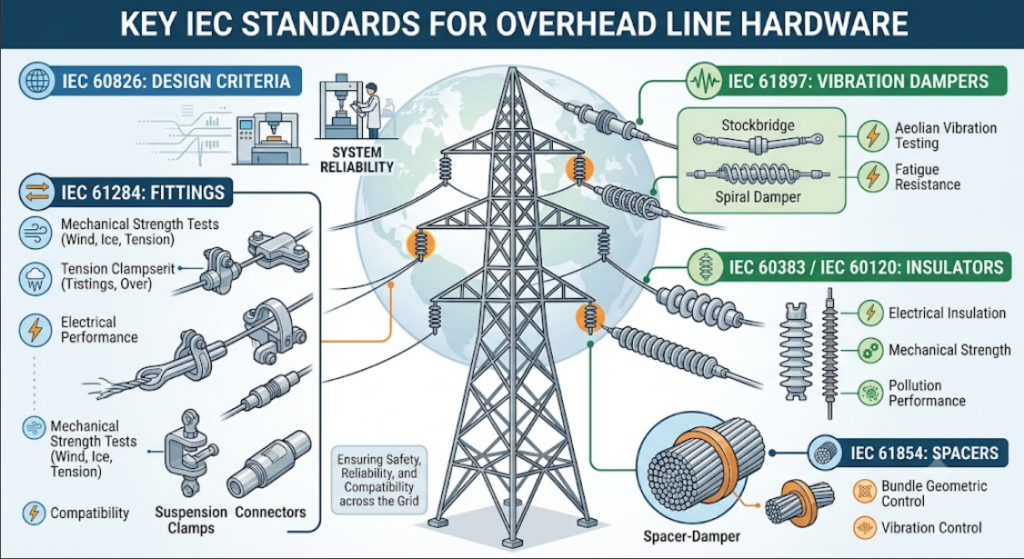
To guarantee that every piece of hardware performs according to technical expectations, there are specific IEC standard codes that strictly regulate overhead line accessories. Some of the most critical standards that must be met in this industry include:
- IEC 61284: This is the most comprehensive standard governing the requirements and testing methods for overhead line fittings. It covers a wide range of evaluations, including mechanical tensile strength tests, corrosion resistance, galvanization quality, radio interference voltage (RIV) tests, and corona discharge assessments.
- IEC 60383: This standard applies to insulators used on overhead power lines with a nominal voltage greater than 1000 V. The insulators and their corresponding attachment hardware must work harmoniously to prevent electrical leakage from the conductor to the transmission tower.
- IEC 60120 & IEC 60471: These standards specifically dictate the dimensions of ball and socket as well as clevis and tongue couplings on insulator strings. Dimensional uniformity is vital so that connecting hardware, such as socket eyes or ball eyes, can be installed with absolute precision without the risk of detachment.
Critical Components in Overhead Line Hardware
Overhead transmission hardware is not a single, simple tool, but rather a complex assembly of mechanical components, each serving a highly specific function. The critical components governed by IEC standards include:
- Suspension Clamps: Utilized to suspend conductors on straight-line suspension towers. IEC standards mandate that these clamps distribute mechanical stress evenly to prevent damage to the conductor cable caused by mechanical fatigue over time.
- Tension Clamps / Dead-end Clamps: Used on angle towers or terminal towers to bear the full tensile load of the conductor. A failure in this component is catastrophic, which is why maximum tensile strength testing under IEC 61284 is strictly enforced.
- Vibration Dampers: Wind blowing across conductor cables can induce high-frequency vibrations (aeolian vibration) that can severely damage the cables and towers over time. IEC-compliant dampers are dynamically tested to ensure their ability to effectively absorb and dissipate this vibration energy.
- Splicing Fittings (Mid-span Joints): Designed to connect two ends of a conductor. These devices must undergo severe electrical resistance testing to ensure the joint does not create an electrical bottleneck that could lead to dangerous overheating.
The IEC Testing Procedures
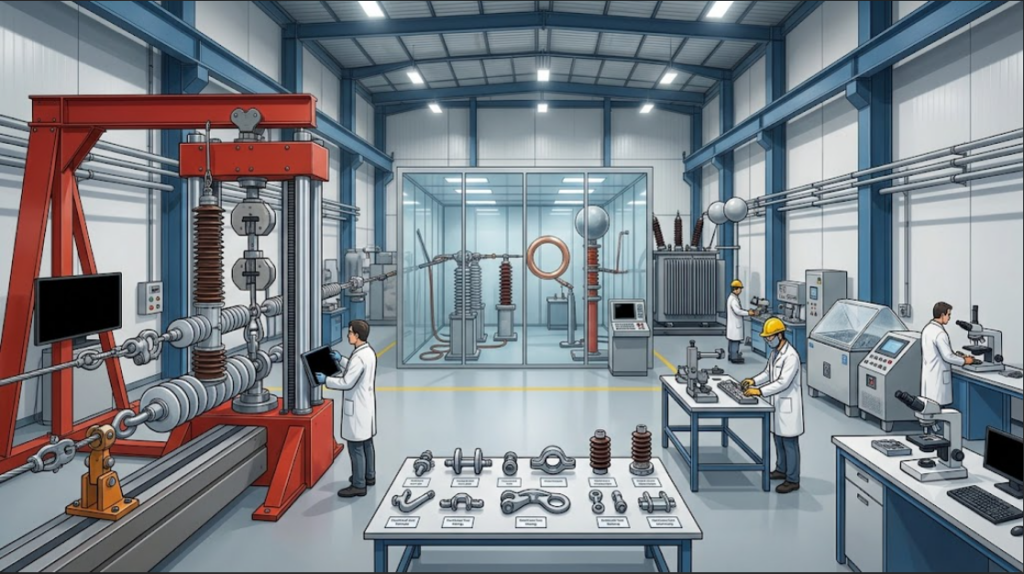
To achieve certification of compliance with IEC standards, overhead line hardware must pass a series of stringent laboratory evaluations. These tests are divided into several distinct categories:
- Type Tests: Conducted on initial designs to prove that the product concept meets all technical standards, including failure load tests and corona voltage tests.
- Routine Tests: Performed on every single product before it leaves the manufacturing facility to detect any material defects, encompassing visual inspections and routine mechanical load checks.
- Sample Tests: Conducted on random samples from every production batch to evaluate metallurgical integrity and verify the thickness of the galvanized coating (zinc plating) for rust prevention.
The ROI of Investing in IEC-Certified Components
For electrical utility companies, EPC contractors, and infrastructure project managers, selecting IEC-certified transmission hardware is not merely a matter of regulatory compliance; it is a strategic financial investment. Substandard, non-certified components might offer a lower upfront cost, but the inherent risk of premature failure and subsequent repair costs is astronomically higher. IEC-standardized products guarantee maximum Return on Investment (ROI) through an extended lifespan, minimized grid downtime, and the protection of the utility company’s public reputation.
Choosing a Trusted Partner: PT Hogn Trans jaya
Given the critical role that overhead line hardware plays in modern electrical infrastructure, sourcing components from a reputable and trusted partner is the foundational step toward the success of your transmission project. This is where PT Hogn Trans Jaya stands out as the premier, comprehensive solution for the electrical industry’s needs.
As a company that places quality and precision at the forefront of its operations, PT Hogn Trans Jaya is deeply committed to providing overhead line hardware that strictly complies with IEC Standards. Backed by profound technical expertise and a highly reliable distribution network, PT Hogn Trans Jaya ensures that every suspension clamp, tension fitting, and vibration damper you utilize is engineered to withstand the harshest environmental challenges.
If your infrastructure project demands electrical material supplies with international specifications, on-time delivery, and professional after-sales service, do not hesitate to consult with our experts.
Visit our official website at hogntransjaya.com to explore our extensive product catalog, learn more about our service portfolio, and discover how we can synergize to build a highly reliable, safe, and world-class electrical infrastructure.
Conclusion
The strict adherence to IEC Standards for Overhead Line Hardware is the core pillar in constructing resilient electrical transmission and distribution networks. Through the standardization of technical specifications, testing methodologies, and component dimensions, the IEC provides an absolute guarantee that electricity can flow safely from generation to destination. To realize these global standards in your next project, partnering with a highly reputable provider like PT Hogn Trans Jaya (hogntransjaya.com) is a smart, efficient, and future-oriented business decision.
